
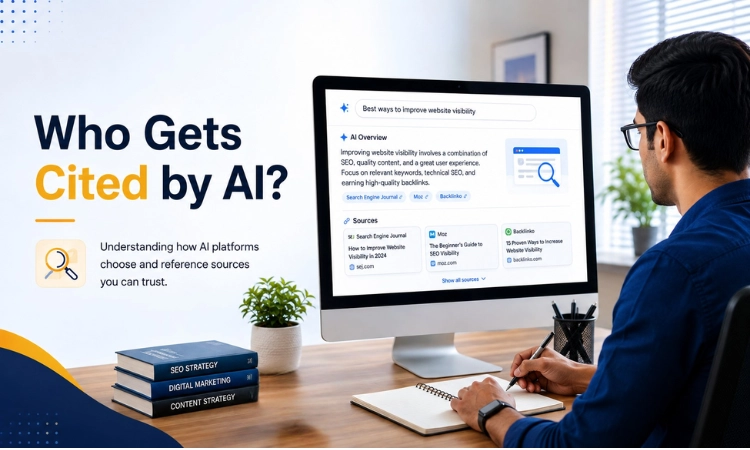
How ChatGPT, Perplexity, and Google AI Overviews Choose What to Cite
The era of those “10 blue links” is fading away at a rapid pace. Today, internet users are moving to conversational AI and expecting answers directly rather than just some links. This type of massive shift has given rise to GEO (Generative Engine Optimization) along with AI Citation Optimization. If your brand is not mentioned under these AI responses, you need to wonder, why is your brand invisible in AI search? To capture this new wave of traffic, you have to understand how AI engines choose sources. Whether it’s Perplexity, Copilot, ChatGPT, Gemini, or Google AI Overviews, every platform has its unique algorithms that define and decide which websites should be put on top: a perfectly direct citation. Let’s start with breaking down the AI search ranking factors and how they can adapt the SEO strategies to win in this modern AI race. How AI Search Engines Select Sources to Cite Before you go deep into these platforms, it’s important to understand the core AI search optimization principles. AI models can scan the web and select sources that are based on those 10 critical answers: Relevance Towards User Query: The content needs to directly answer these specific prompts. Topical Authority: Sites that get recognized as the experts for a specific niche that’s favored. Content Quality & Depth: Complete and comprehensive, well-researched content that outperforms those thin pages. Accuracy and factual support: AI prioritization of variable facts on certain opinions. Freshness of Information: The up-to-date content that’s heavily weighted around the current events. Extractable and clear content: AI needs that easily parsable content (bullet points, clear content). Website Credibility: Higher domain authority plus trust signals do matter. Original Research and Unique Insights: AI goes to unique data, not just some reshaped content. Links and references Supporting Claims: Outbound links for those authoritative sources that can boost trust. Search/Query Context: The AI considers the basic user intent (transactional, informational, etc.) How ChatGPT Chooses Sources to Cite How ChatGPT retrieves information The ChatGPT directly relies on its huge pre-trained data set, but when certain browsing gets enabled (via Bing etc), that pulls out real-time data. It scans the web for pages that they can closely match for the semantic intent and prompts. What makes a website more likely to be cited? For learning how to get cited by ChatGPT, you need to focus on clarity. ChatGPT and other tools. The High Domain Authority (DA) sites are well-structured niche blogs that are frequently pulled. ChatGPT citation example If the user asks, “What are the best KPIs for digital marketing?” ChatGPT will likely establish marketing hubs like Neil Patel and HubSpot because the content defines and lists these types of KPIs for the easily extractable format. How Perplexity Chooses Sources to Cite Perplexity’s citation-first approach Perplexity is built for the “answer engine.” Unlike the traditional chatbots, the core function that will provide sourced answers. This uses real-time indexing for pulling the freshest data available. Factors that can influence perplexity citations When figuring out how to get cited by Perplexity, note that it heavily favors recent news, Reddit Threads (for the authentic user experiences), and authoritative publications. Structured data and clear, concise paragraphs that are heavily favored. Why Perplexity may cite different sources than Google Perplexity doesn’t just look at the traditional SEO for looking at the answerability. A blog that’s ranked #14 under Google that can be cited for Perplexity for the exact, concise answer for the specific query. How Google AI Overviews Choose What to Cite How AI Overviews work with Google Search Google AI Overviews (formerly SGE) that can integrate directly into the traditional SERP. They can synthesize the information from Google’s massive index for providing a summarized answer at the top of the page complete with the source links. What Google May Consider When Selecting the Supporting Sources Google relies on the established Experience, Expertise, Authoritativeness, and Trustworthiness (E-E-A-T) system. Sites that have solid backlink profiles, robust schema markup, and high user engagement are the prime candidates for Google AI Overviews Citations. Why a #1 Google ranking doesn’t guarantee an AI Overview citation Ranking #1 through organic means that you won in the basic SEO game. Although AI SEO does search for snippet-friendly content. If the #1 page has a 3,000-word deep dive but lacks a basic and clear, concise summary at the top, Google can put a shorter but much more direct answer on that low-ranked page. Further, how to rank in AI overviews does require both AI-specific signals and traditional ways. ChatGPT vs. Perplexity vs. Google AI Overviews: How Citation Selection Differs Feature Perplexity ChatGPT (with Browsing) Google AI Overviews Primary Goal Direct, sourced answers Conversational assistance Enhancing traditional search Data Source Real-time web index Pre-trained data + Bing Google Search Index Citation Style Numbered inline citations Inline text links Linked text & source carousels Favors Fresh news, forums, direct answers High-authority, encyclopedic content E-E-A-T, structured data, high engagement How to Increase Your Chances of Being Cited For dominating the AI search, you have to have an advanced checklist for AI SEO services that can work closely with the AI SEO Expert. Here’s the actionable checklist: Create authoritative content. Building topical clusters. Do not just write one post; write a comprehensive hub for the content that can cover each angle of the topic. This can signal the deep expertise for AI models. Answer specific questions directly. Start the sections for a clear and concise answer (that “inverted pyramid” style). If the user asks, “What does the SEO specialist do?” the first sentence should be the major definition. This makes it easy for the AI to extract and cite as well. Add original data and expert insights AI models that are trained for looking at unique values. Publishing the original surveys, expert quotes, and case studies. When the AI sees the unique data, this is more likely for citing the primary source. Support claims with credible sources Linking to the high-authority domains (e.g..gov, .edu for those major industry publications). This
How ChatGPT, Perplexity, and Google AI Overviews Choose What to Cite Read More »