
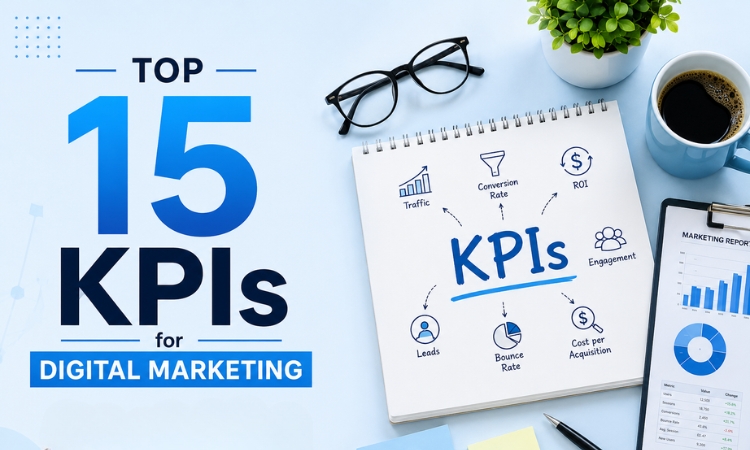
Top 15 KPIs for Digital Marketing Every Business Should Track
Many businesses are doing digital marketing these days. They’re posting on Instagram, running Google Ads, sending emails, publishing blogs. Sometimes, doing all of these together at the same time. But most of them still don’t really know what is actually working. Traffic is coming. Budgets are getting spent. Reports are shared every month. Everyone looks busy. But is the marketing actually bringing leads? Customers? Real revenue? That is where things start becoming a little unclear. This is why tracking the right KPIs for digital marketing becomes so important. Good KPIs tell you whether your marketing efforts are helping your business grow, or you are just throwing money on random channels and hoping something works out. The best marketers, agencies and business owners don’t make decisions based on guesses. They look at numbers. They look at trends. They check performance regularly. And no, tracking 50 different metrics is not necessary at all. Most businesses only need a few important KPIs to understand what is actually happening. So let’s look at the most important ones. What Are KPIs for Digital Marketing? KPI stands for Key Performance Indicator. Sounds complicated. But it is actually quite simple. A KPI in digital marketing is basically a measurable number that helps to understand whether your marketing is doing its job properly or not. For example: How many people are visiting your website? How many are clicking your ads? How many are becoming leads? How many are eventually becoming customers? How much money are your campaigns actually generating? These are all KPIs. Think of KPIs like checkpoints. They tell whether you are moving in the right direction or just wasting time and budget on the wrong things. A strong digital marketing KPI strategy focuses on metrics that actually affect business growth. Not just numbers that look impressive in presentations. Why Are KPIs Important for Businesses? Without KPIs, digital marketing just becomes a guessing game. You might think your Instagram campaign is performing amazingly because it got lots of likes. But what if none of those likes turned into actual leads? You might be getting thousands of website visitors every month. But what if nobody is buying anything? This is exactly why KPIs matter so much. They help businesses to: Understand what is working. Spot problems early Improve campaign performance Reduce wasted ad spend. Generate better quality leads. Make smarter decisions overall. For agencies and even a Digital Marketing Consultant, KPIs become even more important, actually. Clients don’t want to hear “trust us, things are going well.” They want data. That is why marketing agency KPIs, advertising agency metrics and digital agency client quality assessment metrics play such a big role in client reporting and campaign analysis. Top 15 KPIs for Digital Marketing There are hundreds of metrics you can track today. Open your analytics dashboard, and you’ll probably find enough numbers to give yourself a headache. The problem? Most of them don’t really matter. Or at least they don’t matter equally. The goal isn’t to track everything. The goal is to track the stuff that tells you whether your marketing is actually helping the business grow. Let’s get into the ones that deserve your attention. 1. Website Traffic This is usually the first thing people look at. How many people are visiting your website? Simple. If traffic is growing, that’s usually a good sign. More people are finding you. More people are discovering your content. More people are checking out your products or services. But don’t get too excited just because traffic is going up. I’ve seen websites getting thousands of visitors and still struggling to generate sales. Traffic is important. Traffic alone isn’t. 2. Organic Traffic Paid traffic is nice. Organic traffic is nicer. Why? Because you don’t have to pay for every single visitor. Organic traffic shows how many people are finding you through search engines. Someone searches for a question on Google, sees your page, clicks it, and lands on your website. That’s organic traffic. If you’re spending time on SEO, publishing blogs, testing new SEO Strategies, or playing around with Top AI SEO Tools, this is one KPI you should definitely watch. 3. Click-Through Rate (CTR) Imagine 1,000 people see your ad. Only 5 clicked it. Not great. Now imagine 100 people click it. Much better. That’s basically what CTR measures. It tells you whether your headlines, ads, emails, and offers are making people curious enough to click. Because let’s be honest. If nobody clicks, nothing else matters. 4. Conversion Rate This is where things get serious. Traffic is cool, but it’s always the conversions that pay the bills. Your conversion rate tells you how many visitors actually do what you want them to do. Maybe that’s buying a product. Maybe it’s filling a form. Maybe it’s booking a call. Whatever the action is, conversion rate tells you how effective your marketing really is. A website with 1,000 visitors and 100 conversions is often doing better than a website with 10,000 visitors and 10 conversions. 5. Cost Per Click (CPC) If you’re running ads, you’re paying for clicks. The question is… How much? That’s what CPC tells you. A lower CPC can be great. But don’t become obsessed with getting the cheapest clicks possible. Cheap traffic isn’t always good traffic. Sometimes the clicks that cost more are the ones that actually become customers. 6. Cost Per Lead (CPL) Leads aren’t free. Every lead has a cost attached to it. CPL tells you exactly what that cost is. If you’re spending ₹20,000 and generating 200 leads, that’s one thing. If you’re spending ₹20,000 and generating 20 leads, that’s a completely different story. This KPI quickly tells you whether your lead generation campaigns are becoming more efficient or less efficient. 7. Customer Acquisition Cost (CAC) This one separates the marketers from the business owners. Because business owners don’t really care how many clicks you’re getting. They care about customers. CAC tells you how much money you’re spending to acquire one paying customer. Not a
Top 15 KPIs for Digital Marketing Every Business Should Track Read More »