
Benefits of Advertising Online with Google Ads | Boost ROI in 2026
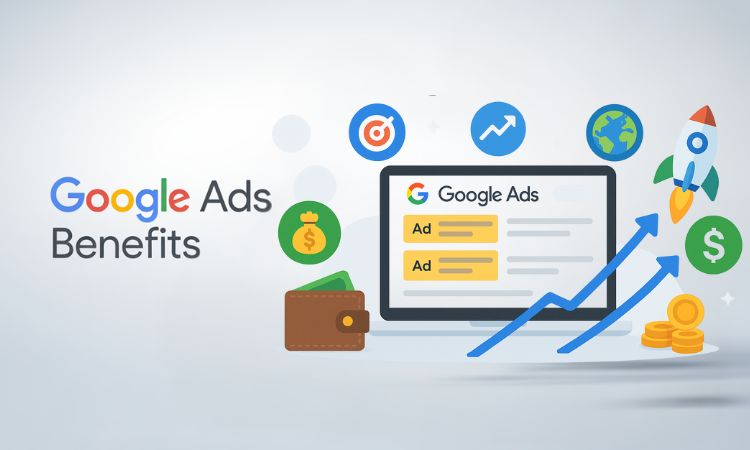
When it comes to online marketing, it’s not always about reaching everyone. Over and above that, it’s about reaching the right people at the right time. That’s exactly what Google Ads helps you do. In 2025, when buyers actually depend heavily on search engines in order to make decisions, the benefits of Google Ads are truly more critical than ever for any business looking to grow fast and smart. So, it’s not just about the clicks, it’s about intent. Google Ads actually connects your products or services to users who are actively searching for them, and gives you a direct path to high-quality leads. The advantages of Google Ads include real-time visibility, full control over budget, advanced targeting, and performance tracking that truly helps you improve over time. Beyond these, AI is also transforming how campaigns perform. This advertising platform utilizes machine learning to automatically optimize bids, select the best-performing keywords, and deliver personalized ads to users most likely to convert. It analyzes a wide range of data in real-time and helps your campaign adapt faster than human hands ever could. Whether you’re running one ad or even a hundred, AI ensures your budget is used efficiently and helps you get more results with less effort. No matter if you’re launching a campaign, or even scaling one, it gives you the tools in order to compete with bigger brands, reach new markets, and turn interest into action, all with measure ROI. In this blog, we’ll uncover how to maximize ROI with Google Ads, and cover key benefits, AI tips, along with common mistakes. What is Google Ads? Google Ads is Google’s online advertising platform that allows businesses to display their ads across Google Search, YouTube, Gmail, Google Maps, and millions of websites in the Display Network. The platform actually follows the pay-per-click (PPC) model, so you only pay when someone clicks on your ad. Beyond that, AI and Machines Learning integration make it more powerful as these help automate bidding, optimize targeting, and personalize ad delivery in real time. No matter if you’re a startup or even a big brand, Google Ads offers smart tools for precise audience targeting, budget control along with performance tracking. From search and display to video and shopping ads, it’s truly designed in order to help you achieve measurable results faster and smarter. Types of Google Ads Campaigns Available Google Ads offers a wide range of campaign types, each designed in order to help you achieve specific marketing objectives, like increasing website traffic, generating qualified leads, driving online sales, boosting brand visibility, or sometimes promoting mobile apps. Here are the main campaign formats: 1. Search Campaigns These text ads appear on Google Search results whenever users look for specific keywords. It’s perfect for capturing high-intent traffic ready to take action. 2. Display Campaigns These are visually rich banner ads and are shown across websites, apps, as well as Gmail. Display Campaigns actually help build brand awareness and reach users while they browse online. 3. Video Campaigns Run your video ads on YouTube, along with other video partner sites. Great option for storytelling, brand engagement, and product promotion. 4. Shopping Campaigns When it comes to shopping campaigns, these ads showcase product images, prices, along with store details just right on the search page when people are browsing the product. Great for e-commerce. 5. Performance Max Campaigns This is called an all-in-one campaign type that uses AI in order to optimize ads across all Google platforms that include Display, YouTube, Discover, Maps, and Gmail with a goal-based approach. 6. App Campaigns App Campaigns are actually designed to promote mobile apps across Google’s properties, and help you drive installs, in-app actions, or sometimes re-engagement. 7. Smart Campaigns Best for small businesses or beginners, Smart Campaigns automate targeting, bidding, and ad creation using Google’s AI. 8. Local Campaigns These are tailored to drive visits to physical locations. Your ads appear on Maps, Search, YouTube, and Display to nearby users. 9. Discovery Campaigns Deliver personalized, scrollable ads across YouTube, Discover feed, and Gmail. Ideal for brand awareness and reaching new audiences. Key Benefits of Advertising with Google Ads When it comes to benefits, the platform actually offers unmatched opportunities in order to connect with the right audience at the right moment. Here’s how exactly it can transform your marketing strategy: 1. Massive Reach Across Google Network Google Ads connects you to billions of users through Google Search, YouTube, Gmail, Maps, as well as millions of partner websites. This wide network ensures your ads appear whenever your audience is active, increasing visibility, brand awareness, and potential leads across multiple digital points. 2. Highly Targeted Advertising With Google Ads, you can actually define your audience using various parameters like location, demographic, interests, devices, and even search intent. Now, this ensures your ads reach only the most relevant users, minimize wasteful spending, and maximize engagement through laser-focused targeting. 3. Full Control Over Budget and Bidding The platform offers complete control over your advertising spend. You can set daily or even campaign-level budgets, adjust bids based on performance, and choose between manual or even automated bidding strategies. This flexibility allows businesses of all sizes in order to manage costs effectively and scale as needed. 4. Immediate and Measurable Results Unlike traditional advertising, Google Ads provides instant traffic and insights. Furthermore, real-time analytics let you monitor impressions, clicks, conversions, and other KPIs. This immediate feedback helps you quickly evaluate what’s exactly working and make necessary adjustments in order to improve performance. 5. High ROI When Managed Well. When it comes to ROI, it can deliver excellent ROI when optimized with the right keywords, ad copies, and targeting. You pay only for actual clicks or conversions, and this makes it a cost-effective option. Continuous testing and refinement can further enhance profitability over time. 6. Remarketing Opportunities It also has remarketing. Remarketing lets you re-engage users who previously interacted with your website or app but didn’t convert. These customized ads keep your brand top-of-mind, gently nudging
Benefits of Advertising Online with Google Ads | Boost ROI in 2026 Read More »