




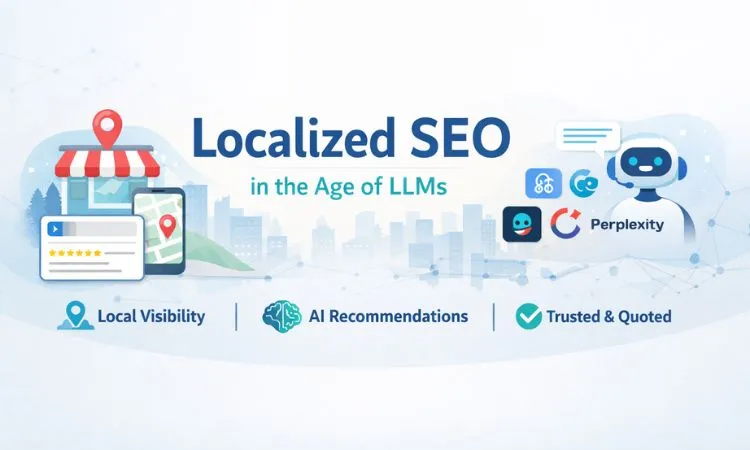
Local SEO for LLMs goes beyond ranking in traditional local results. It actually focuses on helping systems accurately understand, evaluate, and surface your business in local searches as AI-driven discovery becomes more common.
Numerous AI models like ChatGPT, Claude, Perplexity, etc., don’t solely depend on keywords. Over and above that, they analyze context, intent, reviews, content quality, and credibility to decide which local businesses should be highlighted.
We can take a local bookstore as an example. A local bookstore can appear in a voice search for the query “best children’s book near me” as it has a complete profile, recent reviews, as well as perfect content that clearly highlights its specialty.
Similarly, a car repair shop could also be recommended for “reliable brake repair near me” only if it clearly lists services, shows verified reviews, and maintains hyperlocal content across its website. On the other hand, competitors with incomplete profiles or even outdated details are overlooked.
In this blog, we’ll have a look at how LLMs actually understand local searches and which Local SEO strategies work truly best. Furthermore, you’ll learn how to optimize your Google Business profile, create content for your area, use reviews effectively, and structure your site so that AI highlights your business.
Table of Contents
ToggleWhat Are LLMs and Why They Matter for Local Searches?
Large Language Models (LLMs) are actually advanced AI systems that can precisely read, understand, and generate human-like language. Simply put, they don’t just look for keywords; they can also figure out what exactly a user means, understand their context and deliver answers that feel smart and conversational.
Some popular LLMs, such as ChatGPT, Claude, and Perplexity, power engines, chatbots, AI assistants, and question-answering tools, are shaping how people discover businesses online.
For local businesses, LLMs are the secret engine behind AI-powered recommendations. LLMs connect customers with the most relevant alternatives. They actually consider factors like recent reviews, detailed business information, along with locally focused content to determine which businesses to recommend.
Here’s what gives businesses a competitive edge in LLM-powered local SEO:
- Complete business profiles: Accurate NAP (name, address, phone), hours, and services.
- Credible and recent reviews: Social proof that really builds trust with AI and users.
- Hyperlocal content: FAQs, neighbourhood guides, as well as pages that perfectly answer real queries.
- Structured, AI-friendly content: Clear headings, schema, and well-organized information.
- Rich media & local mentions: Photos, videos, as well as citations that boost your credibility.
Moreover, LLMs summarise and highlight context, sometimes by showing answers directly in search results. Optimizing your LLMs is just like giving your business a VIP pass in the AI-powered local search world, and it will help you get discovered, trusted, and chosen over your competitors.
Want More Traffic That Actually Converts?
I help brands drive consistent traffic, quality leads, and real growth with proven performance marketing strategies.
Let’s Talk GrowthHow LLMs Process Local Intent: 5 Key Steps
Below, we’ve outlined a 5-step process showing how models like ChatGPT, and Perplexity rank businesses for local visibility in AI-driven search:
Step 1: Interpret User Intent
LLMs (Large Language Models) start by comprehending what the users truly prefer. For example, a query like “best children’s book near me” is analyzed for location, specific needs, and timing. This step ensures AI delivers results that are aligned with user’s exact intent.
Step 2: Evaluate Business Credibility
The AI models check if your business details are accurate and consistent or not. Here, Google Business Profile comes in. A complete Google Business profile, consistent NAP (Name, Address, Phone), clear services, along with active social presence all boost trust. Credible businesses always get priority in local SEO.
Step 3: Assess Content Relevance
Furthermore, hyperlocal content, relevant FAQs, blog posts, and service descriptions always help AI better understand your offerings. LLMs prioritize businesses whose content directly answers customer’s queries, and provide them higher local visibility in AI-powered search.
Step 4: Analyze Reviews and Local Mentions
Latest, high-quality reviews give a signal of reliability. Several mentions in local blogs, news sites, and community platforms strengthen authority. LLMs use these signals in order to decide which businesses are most trustworthy and influence AI-driven local SEO rankings.
Step 5: Process Structured Data and Deliver Recommendations
Lastly, LLMs interpret structured data like schema markup (Local/Business, FAQs, Products) to clearly understand services, locations, and offerings. Now, this helps AI to confidently recommend your business in local search results, maps, or even voice searches, and ultimately maximize your local search optimization for LLMs.
Core Local SEO Ranking Factors (Traditional + AI Influences)
Local search optimization today is a combination of proven SEO fundamentals and new AI-driven signals. LLMs influence how results are selected and summarized; these factors now work together in order to shape local visibility in Google and AI-powered search.
Here’s how each ranking factor contributes, both traditionally and in the age of AI.
1. Google Business Profile (GBP) Optimization
Your Google Business Profile is the most influential asset in local SEO for LLMs. It actually acts as a primary reference point for Maps, local packs, and AI-generated local answers.
A strong GBP starts with accuracy and completeness:
- Accurate business name, address, phone, hours, and service areas
- Proper primary and secondary categories.
- Clearly listed services and attributes.
Visual and activity signals add another layer of trust:
- High-quality photos and short videos showing real operations.
- Regular posts, updates, and offers that signal freshness.
Your business description truly deserves special attention. An AI-friendly description that clearly explains what you actually do, what you exactly service, and where you operate really helps both Google Maps and AI systems confidently surface your business in local results.
2. NAP Consistency and Local Citations
NAP consistency remains a foundational local SEO ranking factor, but AI has raised the bar. LLMs cross-check your business details across multiple platforms just to confirm legitimacy.
When your NAP (Name, Address, Phone number) precisely matches everywhere, AI observes a stable and trustworthy business. Inconsistencies, even small ones, weaken confidence.
Key citation sources include:
- Google Business Profile, Bing Places, Apple Maps
- Yelp, Facebook, Justdial, Sulekha
- Industry-specific and location-based directories
These listings work well for verification signals, reinforcing your local presence across both traditional and AI-driven local search.
3. Reviews and Reputation Signals
Reviews now impact how AI understands real-world experience, not just how users perceive your brand.
LLMs evaluate:
- Review quality and relevance, not just star ratings
- Recency and consistency of feedback
- Mentions of specific services, locations, or outcomes
It’s also essential to respond to reviews, as it matters a lot. Actually, active responses show engagement and reliability, which strengthens both local search engine optimization and AI trust. From an AI perspective, reviews help answer user-level questions like “Is this business dependable nearby?”
4. Local Links and Mentions
Local links and brand mentions also help AI place your business within its geographic and community context.
Mentions from:
- Local news websites
- Community blogs and event pages
- Chambers of commerce and local organizations
Now, these signals properly support traditional authority and also help LLMs to associate your business with a specific location and niche. Even unlinked mentions contribute to entity recognition, which is really important for AI-driven local SEO.
5. Mobile and User Experience Signals
AI-led search pays close attention to how users interact with your site, especially on mobile.
Strong UX includes:
- Mobile-first design and fast page loading
- Clear navigation and readable content
- Easy access to contact details, services, and location info
However, if users struggle to find information or even leave quickly, then AI interprets that as low usefulness. A smooth, intuitive experience always supports local search optimization and improves your overall chances of being surfaced in AI-powered results.
Hyperlocal Content & Semantic Optimization (AI-centric)
Hyperlocal content is the secret sauce for local SEO for LLMs. This type of content does truly more than just mentioning your city or neighbourhood; it also understands how your business serves the local community. Details, guides, FAQs, event updates, and neighbourhood insights signal relevance and authority to AI.
Below, we’ll explore how to craft hyperlocal content, optimize it semantically, leverage rich media, and structure it for AI, so that your business stands out in AI-driven local search and boosts overall local visibility:
Create Highly Relevant Local Content
Your content should always reflect your neighbourhood, community, as well as the actual questions your customers exactly ask. LLMs prioritize all the businesses whose content directly solves local needs. For example, a small bookstore crafts a guide for “hidden bookstores in downtown” that will drive both search engines and AI recommendations.
Hyperlocal content examples:
- Neighbourhood guides that highlight services or local landmarks.
- Local FAQs that precisely and directly answer common questions in your area.
- Updates for events or sometimes seasonal offerings that are customized to your community.
Use Semantic & Conversational Keywords
- Keep your focus on long-tail, natural phrases that exactly match how people speak, e.g., “late-night vegan bakery near me.”
- Make use of AI tools in order to get an idea of search intent and local conversational queries.
- Include keywords naturally in headers, FAQs, along with content summaries.
Semantic keywords always help AI models extract relevant answers quickly and improve your chances of appearing in voice search and AI-driven local results.
Structured Data & Schema
Structured data ensures your business is easily understood by both search engines and AI models.
- Local Business schema for basic details.
- FAQ schema to answer common questions.
- Product/Service schema for offerings.
Clear, organized schema enhances the chance of being featured in AI summaries, local packs, and voice search results, and ultimately boosts overall local search optimization.
Optimizing for Voice Search & AI Assistants
Voice search now accounts for over half of local searches. Optimizing for voice means writing content that sounds natural when spoken aloud.
- Utilize conversational language in FAQs (Frequently Asked Questions) and services pages.
- Incorporate rich meta data in order to help AI models understand your content.
- Structure content that can be easily picked up by smart speakers and AI-based assistant.
And, this approach ensures that your business is discoverable across voice-enabled devices and AI interfaces.
Rich Media and Video for Local Discovery
Adding images and video strengthens both human engagement and AI understanding.
- Geotagged images showcasing your location or products
- Neighborhood videos highlighting events, services, or experiences
- Video transcripts to make content searchable by LLMs
Optimized visual content allows AI to understand your business contextually, increasing your AI-driven local SEO performance.
LLM-Specific Optimization & Entity Building
LLMs always depend on entities, not just keywords. A strong entity profile helps AI associate your business with a specific niche and location.
- Craft content hubs within your niche topics.
- Get mentions in directories, blogs, along with news sites that are reputable.
- Use internal linking to strengthen semantic clusters
This builds authority and improves the likelihood that your business is recommended in AI-generated local results.
Monitor & Improve AI Search Visibility
AI-driven local SEO requires ongoing monitoring and adjustments.
- Track appearances in AI search and local packs
- Keep track of appearances in AI search and local packs.
- Properly analyse which queries competitors rank for that you really don’t.
- Adjust GBP, content, and schema based on performance trends
Conclusion
Localized SEO for LLMs is indeed redefining how businesses that are operating locally can get visibility in local search. Just by blending proven local SEO strategies with hyperlocal content, semantic optimization, and structure that’s AI-friendly, businesses are able to make it easier for AI systems to understand, trust, and recommend them.
This approach moves beyond short-term rankings and strongly focuses on long-term local visibility, stronger credibility, and content discovery access, AI-driven search, voice assistant, and dynamic local search experiences.
