






These days, the concept and effective execution of digital marketing strategies have the power to transform any business and industry.
Companies across the globe have allotted more of their yearly marketing budget for various online marketing techniques instead of the traditional methods.
However, modern digital marketing techniques are no longer about guesswork. Running campaigns without measurable outcomes is considered a waste of time.
This is why businesses are paying adequate attention to investing in performance marketing strategies rather than the typical process of improving brand visibility.
Modern businesses demand precision and measurable outcomes on investment for every marketing dollar spent.
Therefore, the significance of performance-driven marketing strategies becomes the backbone of digital growth for start-ups, e-commerce brands, and enterprises alike.
With the help of authentic and relevant data and analytics, businesses are ready to optimize their marketing efforts to achieve their short-term and long-term goals while maximizing their Return on Investment (ROI).
Table of Contents
ToggleWhat is Performance Marketing?
Performance marketing is a result-centric approach where businesses or advertisers pay only when a specific action takes place—a click, a lead, a purchase, or a conversion.
When you seek an answer to “What is performance marketing?” you must understand the difference between this one and the traditional strategies.
Unlike conventional marketing techniques, performance marketing allows businesses and marketing experts to track and analyze key performance indicators (KPIs).
These indicators help them determine the effectiveness of their campaign with authentic and up-to-date data.
Unlike old-fashioned marketing, where spending is often tied to reach or brand visibility, performance marketing ties budget directly to results.
Data, as we all know, is always reliable; relying on data and analytics increases the likelihood of making positive changes in your next marketing strategies.
Businesses use this to optimize their campaigns and conduct continuous testing until they identify the most effective marketing strategy.
Marketers monitor the performance of the campaign in real time. By refining their target audiences, they scale the process based on the outcome.
At its core, performance marketing focuses on accountability. Experts design and run certain metrics to evaluate campaigns. These metrics are:
- Cost per acquisition (CPA)
- Return on ad spend (ROAS)
- Conversion rate
- Customer lifetime value (CLV)
- Lead quality and engagement
Modern enterprises rely on structured performance marketing hacks to manage customer acquisition, revenue growth, and retention with measurable precision.

Ready to Scale Your Business with Smarter Marketing?
Book Your Strategy CallBenefits of a Performance Marketing Strategy
A well-crafted performance marketing strategy delivers several benefits to a business that a traditional marketing campaign cannot match. Most notable benefits of these strategies are:
Budget-Efficient
Marketing strategies based on the performance of the campaign allow businesses to remain budget-efficient. They can optimize their spending towards high-performance channels and audiences that eventually reduce the waste of money.
Measurable ROI
Since every action in performance marketing strategies can be tracked and analysed, businesses and marketers can easily understand what is working and what is not. Hence, they can have a clear picture of their investment and measure its return in real time.
Data-Driven Decision Making
Performance Marketing Strategies always allow businesses to make data-driven decisions. They have the data in their hands, analyse it clearly, and make the next marketing move based on it. There is no need to assume the outcome after initiating a campaign. This approach is both straightforward and highly effective in every aspect!
Scalability
With validated performance benchmarks, businesses can easily scale their successful campaigns. Therefore, they can design and create their next campaigns based on that scale to achieve more successful outcomes.
Non-Stop Improvement
Testing and iteration in performance marketing hacks ensure that campaigns evolve according to market changes and consumer behaviour. Hence, there is a scope for making continuous improvement in your campaign. This improvement also helps you keep your marketing strategies relevant.
When businesses implement structured performance marketing strategies, they become successful in predicting growth outcomes with far greater accuracy. Hence, the effort makes sense by all means.
Core Pillars of a Winning Performance Marketing Strategy
1. Clear Goal Setting & KPI Framework
Every successful business campaign starts with clarity. Before designing ads or choosing the right platforms, understand what success looks like to you. The correct definition of success helps you in clear goal-setting. A few examples of specific and measurable goals are:
- Generate 3,000 qualified leads per quarter
- Reduce acquisition cost by 30%
- Increase conversion rate from 3% to 5%
- Achieve a 4x return on ad spend
Once you define such specific goals, you can assign KPIs to monitor the progress. There must be a direct connection to business outcomes with these metrics. Businesses should not count vanity indicators like clicks alone or impressions.
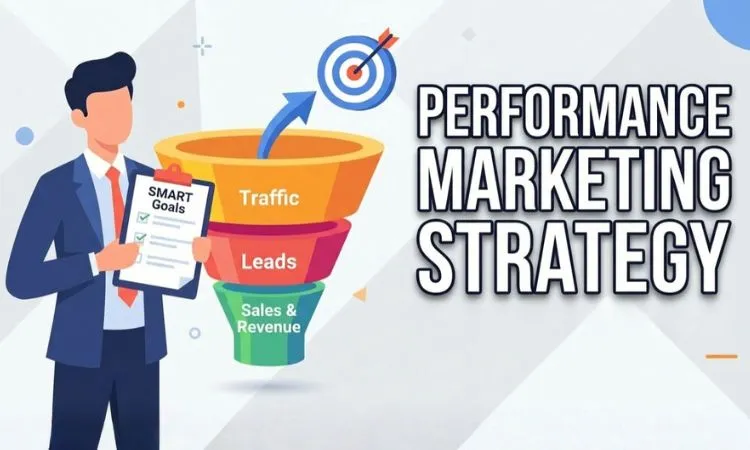
2. Funnel-Based Channel Strategy (Not Just Channel Listing)
Many marketers and businesses make the mistake of channel listing while overlooking the customer journey. A winning campaign maps channels to funnel stages:
Top Stage: Awareness
Introduce the brand to the target audience and generate interest.
Middle Stage: Consideration
Educate the prospects about the service or the product while building long-lasting trust.
Bottom State: Conversion
Come to the sign-up stage or go for the purchase.
Instead of trying to get an answer for “Which channel should we choose?” try to understand “Which channels influence customers at each stage?” This is a structured approach in performance marketing strategy that can ensure prospects will be guided through a flawless path toward conversion.
3. Audience Targeting & Segmentation
A performance marketing expert with multiple marketing campaign ideas always understands the power of segmentation while working on audience targeting. In the process of performance marketing, instead of spending the budget on broad targeting, divide the target audiences into small segments to achieve secure results. These segments can be based on:
- Demographics
- Behavior patterns
- Purchase intent
- Engagement history
- Customer lifecycle stage
Highly segmented audiences often allow personalized messaging, which has the capacity to improve the conversion rate dramatically.
4. Creative Strategy That Drives Conversions
In a successful performance marketing strategy, creativity not only lies in how the campaign is designed but also in how the aesthetic of the plan improves the target audience. It is also about the persuasion. With the right kind of creative marketing strategies, you can encourage your audience to convert into buyers.
High-performing campaigns rely on:
- Clear value propositions
- Strong emotional triggers
- Direct response messaging
- Visual clarity and focus
- Strong calls to action
Small creative changes based on the results of multiple variation testing can bring major changes to the final outcome of the marketing strategy. Some of the most effective performance marketing hacks focus on rapid creative experimentation and iterative testing cycles.
5. Landing Page & Conversion Rate Optimization (CRO)
Even the most creatively designed and perfectly planned ads can fail if the landing page does not have the best features to support conversion. It is helpful for marketing strategy experts to understand the power of correct page optimization tricks while working on the landing page.
A high-performing landing page should:
- Match ad messaging
- Load quickly
- Minimize distractions
- Highlight benefits clearly
- Provide frictionless conversion paths
Conversion rate optimization clearly involves testing page layouts, headlines, offers, and user experiences at regular intervals. This process often produces better results than just increasing traffic on pages.
6. Tracking, Attribution & Data Analytics
Accurate tracking is the foundation of any performance marketing strategy. The results must be tracked and acknowledged on a regular basis to help marketers with correct data analysis. Without reliable data, optimization becomes baseless and impossible to some extent.
Essential tracking elements include:
- Conversion tracking
- Event tracking
- Attribution modeling
- Revenue tracking
- Customer journey analysis
Understanding the key touchpoints in conversion helps marketers allocate the monthly marketing budget more efficiently.
7. Campaign Launch & Optimization Framework
Launching a performance marketing campaign is just the beginning. Continuous optimization is required to get the desired results within a certain time frame. It is important to understand the factors that work under the framework to determine the success rate.
A structured framework includes:
- Testing phase
- Data collection
- Performance analysis
- Scaling winners
- Eliminating underperformers
The most successful performance marketing strategies work as dynamic systems in a business’s entire marketing process that evolve seamlessly and continuously.
Advanced Performance Marketing Tactics
Incrementality & Uplift Modeling
While working on performance marketing tactics, you need to understand one truth: not all conversions are happening because of your campaign. Incrementality analysis has the power to measure the correct influence of marketing by comparing exposed vs. non-exposed audiences.
This analysis can help you in getting the answers to some critical questions like:
- Did marketing strategies drive new customers or just capture existing demand?
- Where should the incremental budget be allocated?
- Which campaigns produce real growth?
AI & Automation in Performance Marketing
The power of AI in content marketing can be understood when the transformation in campaign optimization can be analysed seamlessly. AI systems can easily and flawlessly analyse vast data, predict results, and automate adjustments in real time.
Common applications of AI systems include dynamic creative optimization, automated audience segmentation, and performance forecasting. In recent times, many advanced performance marketing hacks rely on AI-generated results for smarter scaling.
Cross-Channel Attribution & Omnichannel Strategy
Customers usually convert after multiple interactions. Their engagement across several touchpoints before making the final decision is evident and normal. Omnichannel marketing integrates messaging across platforms, while attribution models identify which interactions influence conversions most.
With this strategy, businesses can enjoy better budget allocation, higher lifetime value, improved personalization of the campaign, and a unified customer experience to reduce errors in the next campaign.
Performance Marketing Strategy Checklist
If you want to check whether your latest performance marketing strategy is working correctly or not, this checklist may help you.
- Clearly defined business goals and KPIs
- Relevant audience segmentation
- Funnel-aligned channel selection
- Well-optimized landing pages
- Conversion-focused creative evaluation
- Seamless tracking and attribution
- Non-stop campaign optimization
- Data-driven scaling decisions
- AI-driven optimization according to the situation
- Integrated cross-channel experience
Timely and systematic implementation of these steps ensures that your marketing strategy operates efficiently and predictably. By implementing a structured performance marketing strategy, companies gain the ability to control growth rather than chase it.
Building a Sustainable Performance Engine
Whether you are a business owner or a marketing specialist, you need to keep one thing in mind: a winning marketing system cannot be built overnight. It evolved through structured planning, continuous execution, and disciplined learning.
Successful businesses consider marketing as an integrated performance engine and not a collection of unplanned and detached campaigns. Advanced performance marketing strategies combine data, creativity, and technology into a unified framework that delivers measurable impact. It is about building a predictable engine that continuously drives revenue, efficiency, and long-term competitive advantage.
