





Did you know that around 93% of marketers use AI tools to generate content faster? Yes, AI in content marketing is very common right now. It’s writing headlines, suggesting blog outlines, generating social posts, and even answering customer questions in real time. Naturally, content marketing couldn’t escape its influence. From startups to global brands, everyone is experimenting with AI tools to create content faster and at scale.
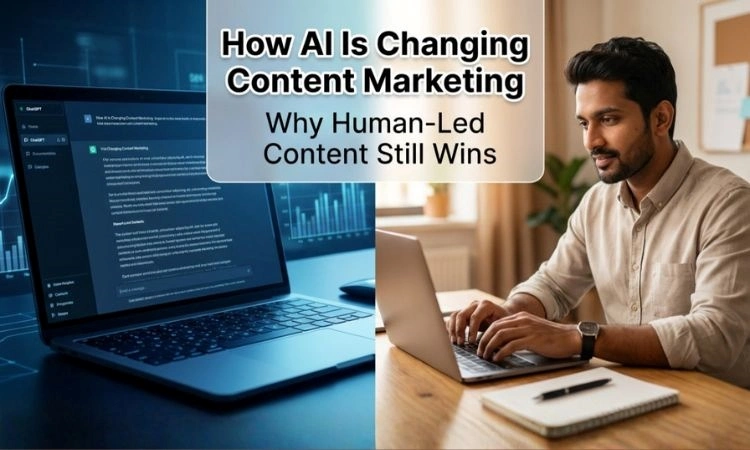
But here’s the thing that often gets lost in the hype: AI is changing how content is produced, not why content works.
There’s a growing assumption that AI will eventually replace writers, strategists, and marketers altogether. In reality, what we’re seeing is very different.
AI is not a replacement for human thinking. AI is a support system, and is great for research, speed, and structure, but limited when it comes to insight, judgment, and connection.
This blog breaks down the real role of AI in content marketing, where it genuinely adds value, and why human-led content strategy continues to outperform purely machine-generated output. More importantly, we’ll look at how brands can combine the two in a way that actually drives results.
Table of Contents
ToggleWhat Is AI Content Marketing?
In simple terms, AI-assisted content marketing is the use of artificial intelligence technology to help with content planning, researching, writing, or even optimisation.
So, what does AI-assisted content marketing look like?
- Initial draft writing
- Research summarisation
- Topic or headline suggestions
- Content outlining
- Keyword research or readability optimisation
This is why AI in content marketing has become so popular. It’s quick. It’s easy. And it’s incredibly efficient. In fact, according to Ahrefs, at least 74.2% of new web pages contain some amount of AI-generated content.
However, here’s the thing to keep in mind:
AI cannot think; it can only predict.
AI predicts based on the data it has been fed. Not on real customer pain points. Not on business needs. Not on emotions.
So, why is this important to understand?
Humans lead the thinking, strategy, and experience, and AI supports the execution and efficiency.
And when this balance is right, content can become scalable and meaningful.
The Core Truth About Content Marketing in the AI Age
Despite all the technology available to us, the core of content marketing has remained the same.
Good content still wins because it:
- Solves real problems
- Reflects real experiences
- Establishes real trust
- Demonstrates real understanding of the customer’s context
These are human qualities.
And while using AI in content marketing can help you create content, it cannot:
- Have first-hand experiences
- Understand the inner workings of a business
- Feel emotions such as frustration, excitement, or uncertainty
- Make judgment calls on nuanced information.
That’s why experience-based content continues to beat generic, AI-focused articles. Just giving information doesn’t work nowadays. You also need perspective. It’s about wanting to know why something works, why it doesn’t, and what to do instead.
Even search engines are facilitating this change. Experience-based, helpful content is being favoured over articles that are simply rehashing what’s already been written on the internet. This is where human-created content is at a definite advantage.
AI can tell you what is common. But only humans can explain what actually works.
This is the essence of the ongoing debate around human content vs AI content. It’s not necessarily about which is better; it’s about understanding what each brings to the table.
Where AI Truly Helps in Content Marketing
AI is an amazing tool if used correctly. However, the main problem is that there are just too many misconceptions. Let’s consider some scenarios where AI actually helps.
AI for Content Research
Research is time-consuming, but that’s where AI can really shine.
It can:
- Summarise long reports
- Pull commonly discussed points from various sources.
- Identify trending topics in a given niche.
- Highlight frequently asked questions.
This is where AI is really helpful, especially during the initial stages of creating a content marketing plan.
However, speed is not the same as strategy.
AI can’t determine what information is actually important to the target audience. It can’t determine what information is important to the product being sold. This is where humans are needed.
AI can be a quick digital marketing consultant, but it can’t be a strategist.
AI for Content Ideas & Structuring
AI can:
- Offer blog topic ideas using keywords
- Develop basic outlines
- Offer several approaches to a single topic.
- Overcome writer’s block.
This can be especially helpful when you have a large volume of content to create. A good outline can help writers stay focused on what’s most important.
Again, the quality of the content will depend on the quality of the guidance provided to the AI. Without human input, the ideas will be vague and unoriginal.
Where Humans Still Lead
Here’s where the difference becomes obvious, and the importance of human-led content strategy shines through.
Just posting content without an end goal won’t work. Each piece of content should contribute to a broader goal: brand awareness, lead generation, trust establishment, or customer education.
Humans understand:
- The business goals
- The sales objections
- The competitive landscape
- The market’s maturity
AI doesn’t and can never understand any of this.
And this is why an effective AI content marketing strategy begins and ends with human input. Without this, the content may be accurate but irrelevant.
Experience, Examples & Opinion
Some of the most popular content on the web is not perfect or polished. It’s raw, honest, and often free of any bias based on real-life experiences.
Humans contribute:
- Personal experiences from their work
- Lessons learned from their failures
- Controversial opinions
- Intricate advice
These are all things an AI lacks because it doesn’t have experiences to draw from.
And this is also why experience-based content tends to do better in the long run: it’s hard to replicate, hard to fake, and easier to believe in.
Brand Voice & Trust Building
Every strong brand has a voice. Some are playful. Some are authoritative. Some are empathetic.
AI can mimic tone, but it doesn’t understand it.
Maintaining a consistent voice, building emotional connection, and earning trust requires human intuition. Readers can sense when content feels generic or robotic, even if they can’t explain why.
Trust is built over time, through consistency and authenticity. That’s something only humans can lead.
The Human-Led, AI-Assisted Content Model (Done Right)
Think of the content creation process as a pipeline. At every important juncture, humans are in the driver’s seat, and AI in content marketing is there to support.
Step 1: Humans Define the Direction
First and foremost, humans need to define the direction of the content before they start using AI:
- What is the topic about, and why is it important to talk about it now?
- Who is the content actually written for?
- What is the search intent behind the content? Is it to inform, compare, or sell?
- What is the actual message that the content is trying to convey?
Defining the goal and the direction is one of the most important steps during content creation. However, AI cannot do this.
Why? AI knows nothing about the marketing funnel, the target customer profile, or the positioning.
Without the direction and guidance of humans, even the best AI content will sound shallow and generic.
Step 2: AI Supports Research and Exploration
But once the direction is set, AI is extremely helpful.
- It can summarise competitor content, find common questions about the topic, and identify industry trends.
- It can find data points and statistics.
This is the part of the content marketing process where AI-assisted content marketing is actually beneficial.
But humans are the ones who determine what is important and what is irrelevant.
Step 3: AI Helps with Structure, Not Substance
One thing AI is good at is creating outlines, structuring content, headings, and creating content flow. However, just having a good outline and structure cannot provide value to your target audience. You need substance
What is substance?
- Real-life examples.
- Lessons learned.
- Opinions.
- Advice.
Step 4: Humans Add Experience, Voice, and Judgment
This is where content becomes memorable.
Humans refine:
- Language to make it sound natural, not robotic
- Examples to make them realistic
- Tone to ensure it matches the brand
- Arguments to make them sound thoughtful, not obvious
This process transforms the content from technically correct to experience-based content that people actually want to read.
And it’s where trust is also built.
Step 5: Human’s Own Final SEO and Quality Control
While AI can provide keyword options, it’s the human’s responsibility to ensure the content meets the needs of the search engine and the reader.
This includes:
- Ensuring the content actually meets the search engine’s intent
- Avoiding keyword stuffing
- Finding the balance between readability and keyword usage
- Cutting repetition and filler content
If you’ve tried everything but are still confused about how to rank content, then you should try modifying your content to help the reader.
This final step of the human process makes all the difference between content that sticks and content that goes nowhere, and it’s the key to any successful AI content marketing strategy.
What Happens When Businesses Rely Too Much on AI
While going ‘AI First’ sounds good on paper, it creates significant problems down the line, which many businesses only realise once they notice the decline in performance.
1. Content Becomes Generic
When you create content using the same data and trends, the content itself becomes generic and unoriginal.
You’ll notice:
- Repetitive language
- Predictable format
- Safe, obvious content
- Lack of point of view
When all content sounds the same, none of it stands out.
This might be one of the most obvious drawbacks of human content vs AI content, but it’s true: AI content blends in, while human insight creates differentiation.
2. Originality Disappears
AI does not generate new content; it simply rearranges the content it was fed.
This means:
- Lack of new angles
- Lack of contrarian viewpoints
- Lack of lessons learned
Over time, this results in a library of content that looks full but says nothing at all and makes the user feel disengaged.
Originality is one of the hardest things to scale, but it is the easiest thing to lose.
3. Engagement Drops, Even If Traffic Doesn’t
The content produced by AI tools might still have a good ranking, especially for low-competition terms. However, the engagement figures will often be different.
The common signs of AI-generated content include:
- High bounce rate
- Low scroll depth
- Low conversions
- Low shares and saves
The reason for this is that the user intuitively knows that the content was not created with the intention of engaging them.
4. Trust Levels Begin to Decline
Trust is not something that is developed through quantity. Trust is developed through consistency, through being able to communicate in a simple and honest manner.
If a brand produces a large volume of content using AI tools, here’s what happens:
- Messaging becomes inconsistent
- Tone becomes inconsistent
- Claims and statements appear shallow and superficial
- Authority is undermined
Once trust has been undermined, it is difficult to recover, regardless of the volume of content that is being produced.
5. Rankings Start to Drop
Search engines have become increasingly focused on helpful and detailed content.
Content developed by AI tools and without any human input will:
- Not demonstrate any real authority on the topic
- Not have any depth or specificity
- Over-optimise and fail to satisfy the intent behind the search query.
This is where businesses realise that speed alone isn’t a strategy.
6. Users Can Spot Robotic Content Instantly
Audiences are getting smarter. They’ve read enough AI-generated content to recognise:
- Over-polished neutrality
- Excessive generalizations
- Lack of emotional nuance
Once users associate a brand with low-effort content, it impacts perception far beyond SEO.
Conclusion
AI has undeniably changed content marketing, but not in the way many feared.
The real advantage doesn’t belong to brands that replace humans with machines. It belongs to those who understand how to combine human thinking with AI efficiency.
Human content is still the competitive advantage. AI is a productivity tool, not a content owner.
Brands that invest in human-written content, supported by smart AI workflows, will continue to build trust, authority, and long-term visibility. Those who rely solely on automation may gain speed, but they lose connection.
