








Table of Contents
ToggleWhat exactly is GEO (Generative Engine Optimization)?
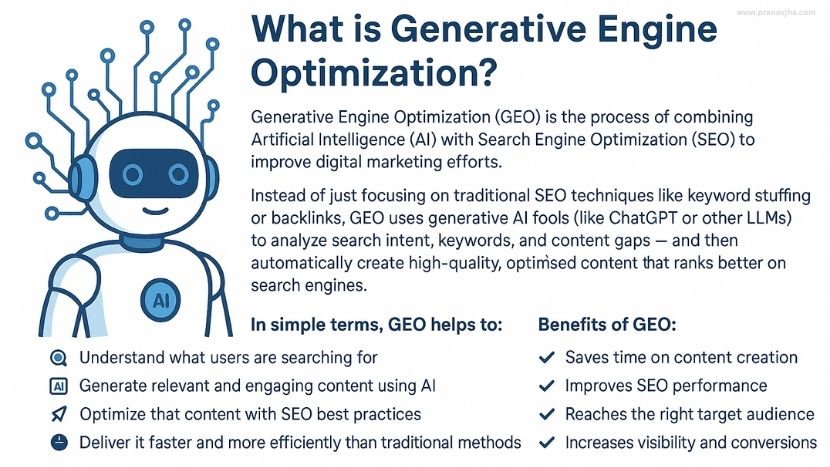
Why is GEO important?
Impact on organic search
Evolution in user search behavior
For example…
- their gender
- their running experience
- their injury history
- that they have wide feet
- what previous shoes did they use and like
What are the benefits of GEO?
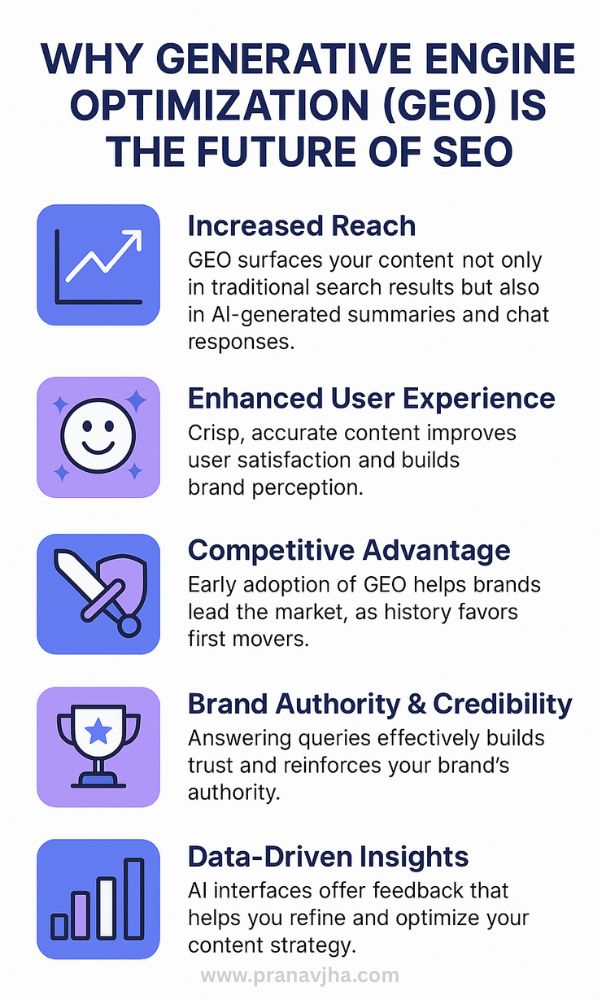
- Increased reach: Properly implementing GEO strategies can surface your content not only in SERPs but also in AI-driven overviews and chat responses.
- Enhanced user experience: Answering users with crisp and exact details to their queries boosts user satisfaction and brand perception.
- Competitive advantage: History tells us that the one who grabs the early opportunity rules the market. Therefore, GEO is still in the early phase, and establishing a solid base will benefit it in the long run.
- Brand authority and credibility: By adapting to the new and demanding structure of content—crisp and to the point—you will help gain the users’ trust, further building an authority and credibility for your brand.
- Data-driven insights: AI interfaces often provide feedback on which answers they choose, enabling precise optimization of content.
- Future-proofing your SEO strategy: Walking with the trend is better than staying put. Therefore, adapting to this new GEO trend will only strengthen your SEO strategies, making your SEO strategies effective.
GEO vs. Traditional SEO: Key Differences and Similarities
How Is GEO different from traditional SEO?
Here are a few differences GEO has compared to SEO:
- AI-Powered Answers vs. Traditional Listings: While SEO ranks websites on search engines, serving as a link, meaning users have options to other links over yours, further decreasing your CTR and organic search traffic. But if you write and optimize your content as per GEO standards, including a direct and crisp answer, your answer will be shown on AI Overviews, further increasing your chances of getting referral traffic.
- Meaningful Context Over Metadata: GEO specifically focuses on the content quality and its context while SEO focuses on keywords and metadata to rank the content/websites on SERPs.
- Blending Insights from Multiple Sources: GEO enables AI to combine various insights and content from multiple sources for a user’s query. However, SEO focuses on ranking a single page based on the targeted keyword.
- Decoding Deeper Search Intent: GEO enables AI to go deeper into users’ search queries, unlike SEO, which only focuses on keywords to rank webpages.
- Keeping Pace with Evolving AI Logic: While traditional search engines may have three to four updates yearly, AI models continuously learn and update.
- Structuring Content for AI Readability: GEO focuses on quality content and formatting like schema, summaries, FAQs, etc. These formation techniques make content easily digestible for AI models to understand and further use in their answers.
- Shifting from Keyword Research to AI Behavior Mapping: GEO relies on analyzing how AI tools cite, summarize, and prioritize content, while SEO focuses on meta titles, meta descriptions, backlinks, keywords, etc., to rank websites on SERPs.

How is GEO similar to traditional SEO?
The following are a few key objectives both GEO and SEO share.
- Shared Mission – Getting Your Content Seen: Both GEO and SEO work on the core objective of increasing the online visibility and reach to your target audience. However, both also promote the content readability, its quality, and how exactly it matches with users’ queries.
- Strategic Language – Keywords Still Matter: GEO does not demote keyword usage, but it does raise a red flag when overused. Therefore, both focus on using minimal and natural keyword insertions wherever possible in the content.
- User-First Thinking at the Core: In SEO, TOFU, MOFU, and BOFU specifically focus on user intent, while GEOs also look for crafting intuitive, user-centric content and providing users with the best experience of consuming the content.
- Quality Is Still King (With Context to Match): GEO adds a modern spin on the timeless content principle while tying in contextual relevance for GEO and E-E-A-T.
- Trust Wins – Authority Is Earned, Not Claimed: Both work towards building authority on the internet. And both rely on the superior quality of content.
- Staying Ahead of the Curve: Both rely on constantly getting updated with the market trends and user behavior.
How does GEO work?
Generative Engine Optimisation unfolds through several interrelated steps:
1. Generative AI research and analysis
- It’s necessary to know which AI tool to optimize for. And to know that, you need to dive deeper into knowing your target audience and which AI tools they frequently use.
- Now, to get your hands on those AI tools, conduct deep AI research, including keyword and semantic research, brand perception research, competitor research, content research, and response analysis.
2. Content quality and relevance
- Set the context right: Write content that falls under the specific topic you’re writing about.
- Keyword relevancy: Explore and use keywords that directly align with the user’s intent.
- Unique content: Rephrasing or plagiarizing content is a red flag for SEO and GEO. Craft content that showcases your uniqueness. Follow the E-E-A-T formula to deliver freshness in the content.
3. Content structure and clarity
- Header formation: Keep your headers short and without jargon. This simple hack helps your users and AI-driven search engines to understand your content easily. Use proper heading formation like H2, H3, and H4 headings.
- Be direct: If you can answer a query in one sentence, do not write another sentence to look better because SEO and GEO promote direct answers that quickly address a user’s query.
- Structured data: All the things that marketers use to rank a website on SERPs, like schema markup, meta title, meta descriptions, alt text, etc., are also encouraged by GEO.
- Content readability and clarity: Use bullet points, write short sentences and paragraphs, and answer a user’s query directly with original data and sources available.
4. Content distribution and engagement
5. Technical SEO
- Relying only on keywords: Focus on answering questions thoroughly with supporting data and examples.
- Ignoring structured data: Implement schema markup (FAQPage, HowTo, Article) to enable AI to pull accurate info.
- No clear answers or summaries: Place a one-sentence summary at the top of each piece, followed by an in-depth explanation.
- Outdated or untrustworthy content: Regularly audit and refresh to ensure accuracy, adding the latest stats or industry developments.
Conclusion
FAQs
1. Why is GEO important for digital marketing?
GEO ensures visibility in AI-driven search interfaces that are increasingly replacing traditional result listings, helping brands maintain and grow organic reach.
2. Can GEO replace SEO completely?
No. GEO complements SEO by targeting generative AI platforms, but foundational SEO practices (site health, backlinks) remain crucial.
3. How do I know if my content is GEO-optimized?
Check if your pages are cited in AI summaries or chat responses and whether they feature structured data and clear answer blocks.
4. What types of content work best for GEO?
Concise summaries, FAQs, how-to guides, and entity-rich articles that use structured data tend to perform well.
5. Do I need technical skills for GEO?
Basic understanding of structured data (schema.org), HTML, and content structuring is helpful—advanced technical skills aren’t always required.
6. How do I optimize for Google SGE and other AI tools?
Implement schema markup, provide answer summaries, build authoritative content clusters, and test performance in AI interfaces.
7. Is GEO worth investing in for 2026 and beyond?
Absolutely. As AI search adoption grows, GEO will become a primary way to secure organic visibility and user engagement.
