

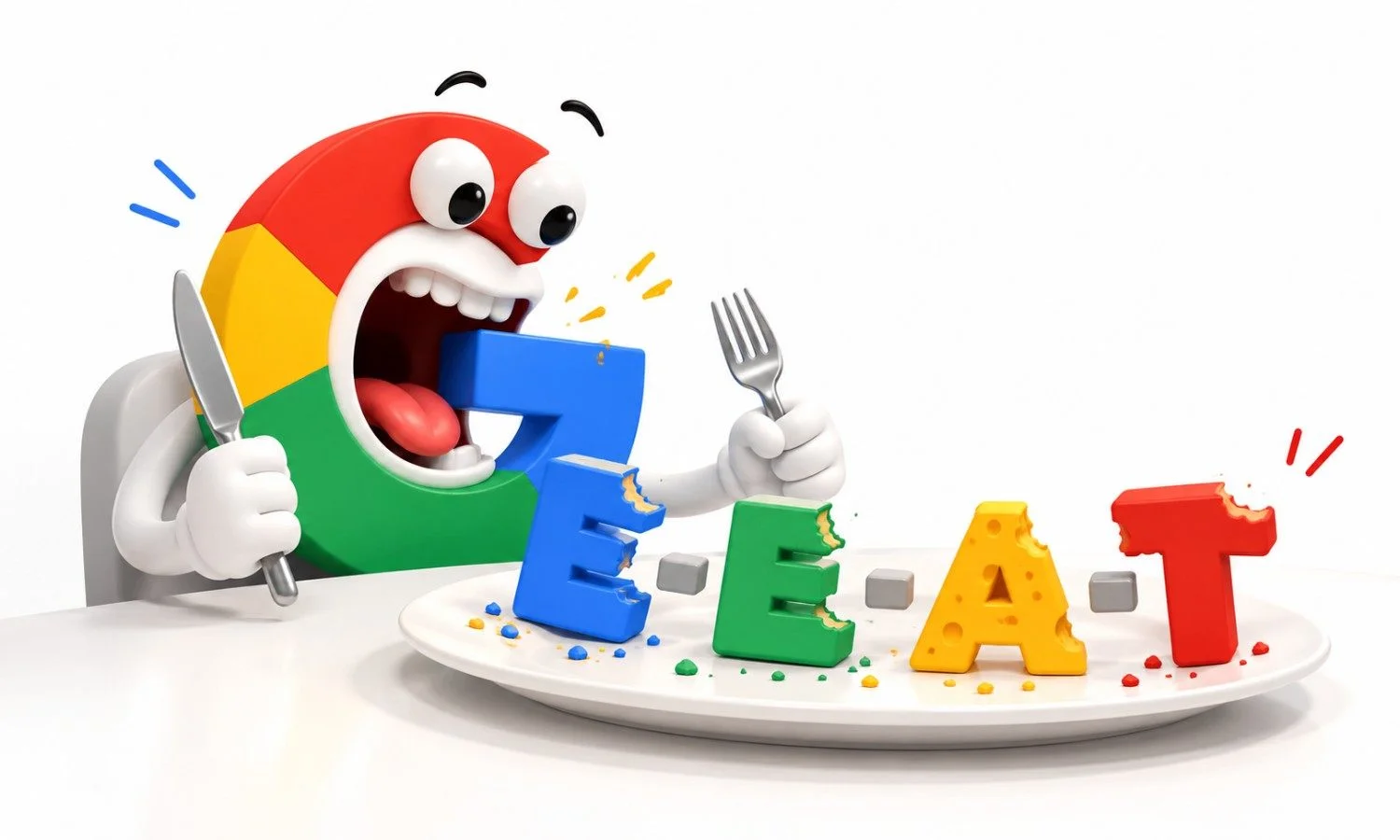


Google E-E-A-T stands for Experience, Expertise, Authoritativeness and Trustworthiness. It is the yardstick Google hands to its human quality raters when they decide whether a page deserves to be on the first page, and it is the closest thing we have to Google saying out loud what its ranking systems, and now its AI Overviews, are trying to reward.
There is no E-E-A-T score. Nobody at Google is typing a number into a box. But everything behind those four letters (who wrote the page, what they’ve actually done, who vouches for them, whether a stranger can trust the page with their money or health) is something you can see, measure and fix.
I’ve been doing SEO since 2012, and I have watched plenty of sites with better backlinks lose to sites with better proof. For years I couldn’t explain it to clients properly. E-E-A-T is the explanation. Let me show you how it works, with examples from India and the US, and how to build it on purpose.
Table of Contents
ToggleWhat Is Google E-E-A-T?
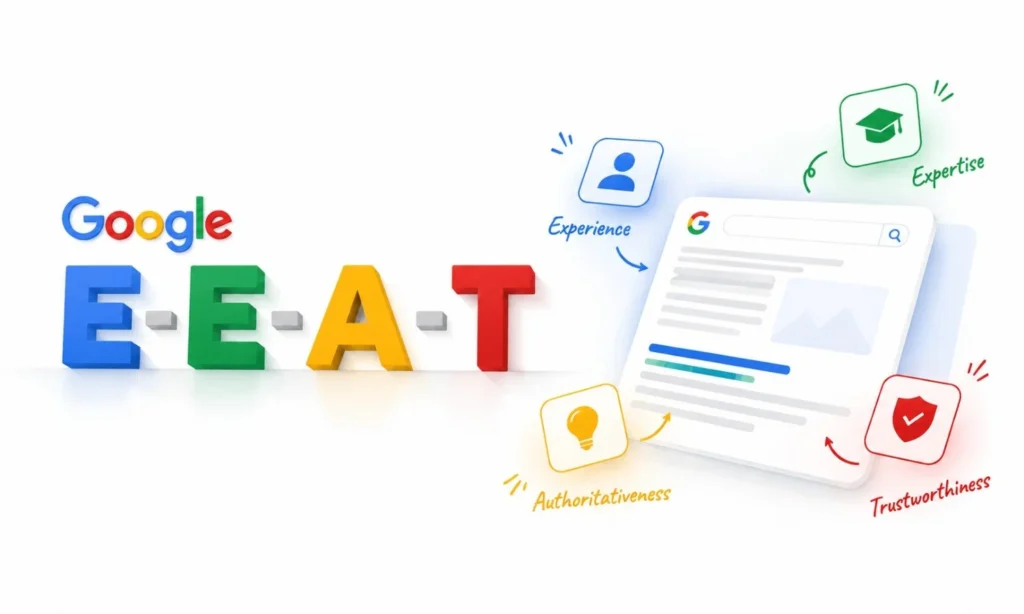
E-E-A-T is the set of four qualities Google tells its Search Quality Raters to look for when judging Page Quality. It first appeared in the Search Quality Rater Guidelines (the QRG) in 2014 as E-A-T. The extra E, for Experience, was added on 15 December 2022. The current QRG was revised on 11 September 2025 and runs to about 180 pages.
Remember this
Trust is not one of four equal pillars. It’s the centre. Google’s wording is blunt: a page that is untrustworthy has low E-E-A-T no matter how experienced, expert or authoritative the creator looks. The other three are the evidence you present to earn trust.
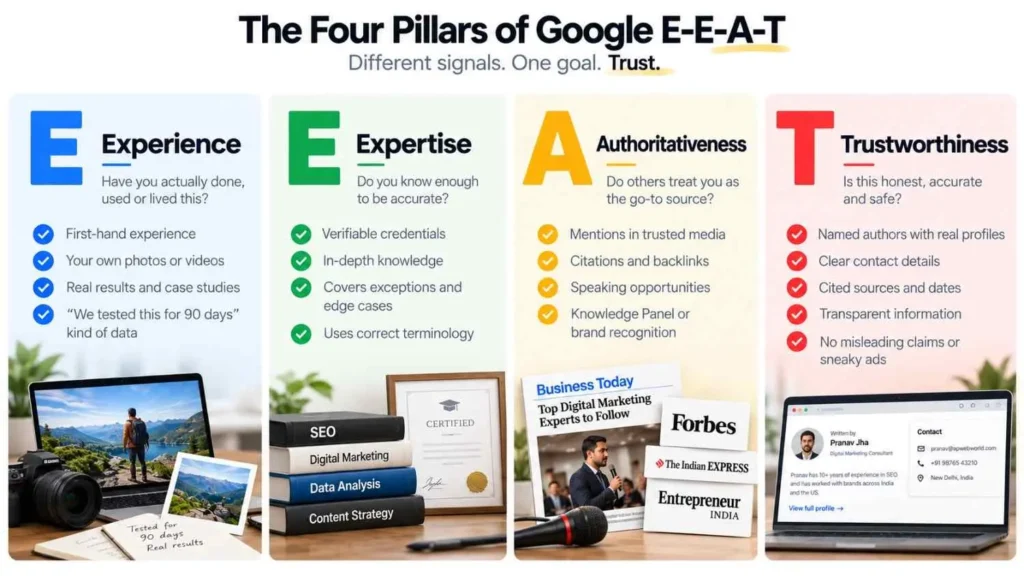
Letter | What Google is really asking | What it looks like on a page |
|---|---|---|
Experience | Have you actually done, used or lived this? | Your own photos, first-person results, “we ran this for 90 days” numbers |
Expertise | Do you know enough to be accurate? | Verifiable credentials, depth that covers the exceptions, correct terminology |
Authoritativeness | Do others treat you as the go-to source? | Press mentions, citations, speaking slots, Knowledge Panel |
Trustworthiness | Is this honest, accurate and safe? | Named authors, contact details, sources, dates, no sneaky ads |
The way I explain it on a first call: Expertise is what you know. Experience is what you’ve done. Authority is what other people say about you. Trust is whether a stranger would act on your advice with their own money. Easy to say, hard to fake.
From E-A-T to E-E-A-T: How We Got Here
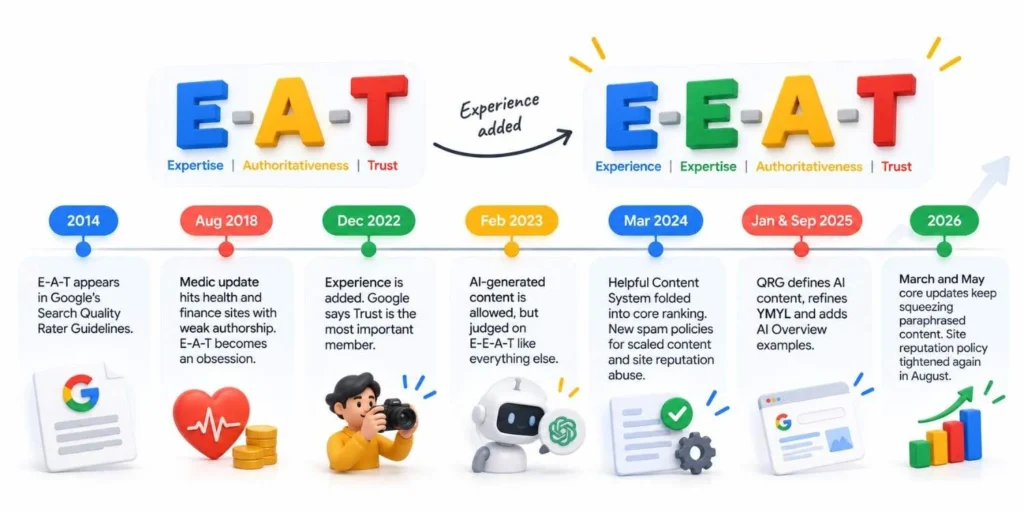
E-E-A-T didn’t drop out of the sky. Every change came after Google noticed a gap between what was ranking and what deserved to rank.
When | What changed |
|---|---|
2014 | E-A-T appears in the Quality Rater Guidelines |
Aug 2018 | The “Medic” update hits health and finance sites with weak authorship. E-A-T becomes an obsession overnight |
Dec 2022 | Experience is added. Google says Trust is the most important member |
Feb 2023 | AI-generated content is allowed, but judged on E-E-A-T like everything else |
Mar 2024 | Helpful Content System folded into core ranking; new spam policies for scaled content and site reputation abuse |
Jan & Sep 2025 | QRG defines AI content (mostly auto-generated pages can be rated Lowest), refines YMYL, adds AI Overview examples |
2026 | March and May core updates keep squeezing paraphrased content; site reputation policy tightened again in August |
Why did Experience get added? Because by 2022, “best running shoes” returned ten pages written by people who had never laced one up. Reddit threads started climbing for the same reason. Google formalised what users were already telling it.
Is E-E-A-T a Ranking Factor?
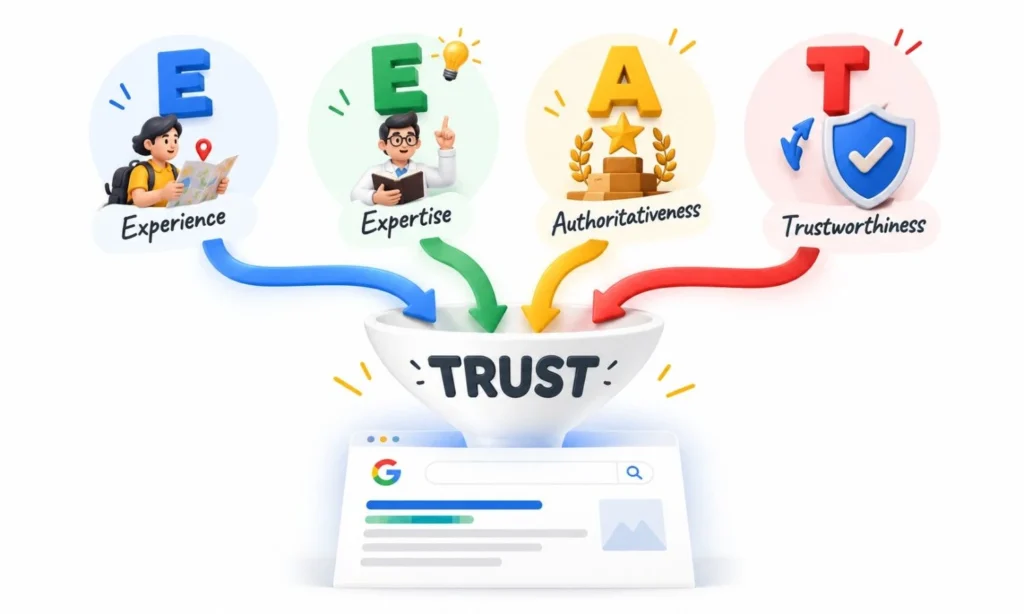
No. And yes. Both are true. Google employs thousands of quality raters who grade real search results against the QRG. Their grades don’t move your page. They tell engineers whether an algorithm change made results better. The engineers then tune the ranking systems until things a machine can measure line up with what raters call high E-E-A-T: who the author is and where else they appear online, how often your brand is mentioned next to the topic, link quality, whether your facts agree with trusted sources, how users behave on the page, how fresh it is.
Bottom Line
There’s no E-E-A-T dial. But if a rater couldn’t Google your name and work out who you are and why you’re qualified in ten minutes, the algorithm can’t either. Build for the rater and the machine follows.
YMYL: Where E-E-A-T Decides Everything
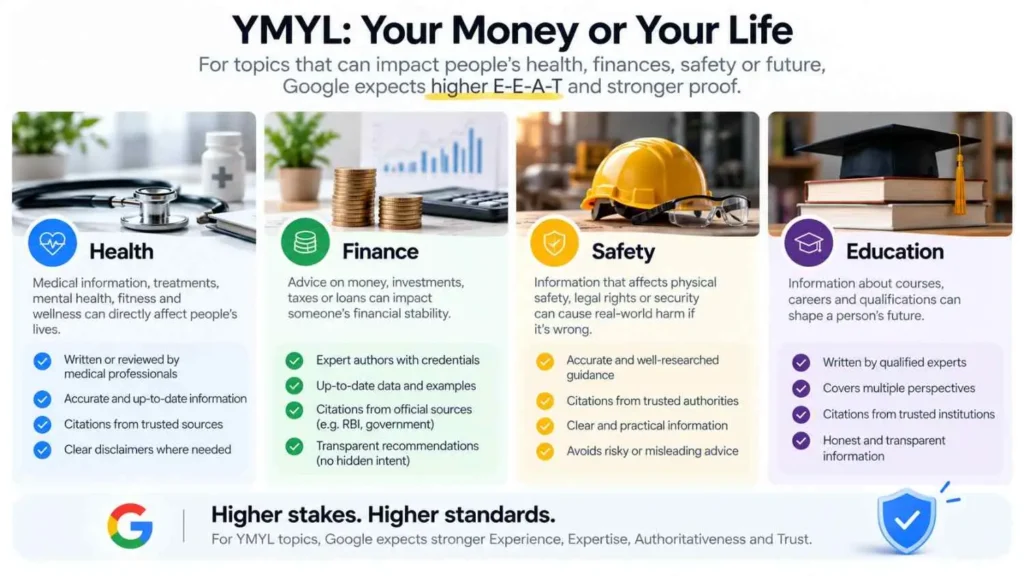
YMYL means Your Money or Your Life: topics where a wrong answer can hurt someone’s health, finances, safety or well-being. Since the 2025 guidelines, Google defines YMYL by the harm a topic could cause, not by a fixed list. Which means your page can be YMYL even if your site isn’t.
Looks low-risk | Actually YMYL |
|---|---|
A travel blog | “Is Kashmir safe to visit in 2026” |
A SaaS website | A comparison page nudging someone towards a ₹50 lakh contract |
A coaching institute blog | “Best IAS coaching in Delhi” that influences a career decision |
The Indian coaching sector learned this the hard way in the 2023 and 2024 core updates, when anonymous “best IAS coaching in Delhi” listicles lost page one to institutes that simply put their faculty’s names on the page and published student results.
The Four Pillars, With Examples
Pillar 1 · Experience: prove you've actually done it
Experience is first-hand involvement. Google added it because expertise can be borrowed from a textbook; experience can’t, and it’s the one thing AI content struggles to fake.
Market | Example |
|---|---|
India | Zerodha Varsity ranks for brutal finance queries without buying a link, because the modules are written by people who trade, with real chart screenshots and losses discussed openly. Our own Hostinger review has outranked higher-DR affiliate sites for years because we actually host client sites on it and show the uptime data. |
US | Wirecutter tells you how many hours of testing went into every pick. Reddit’s climb in Google since 2023 is proof that Google wants lived experience over polished copy. |
Do this:
- One original image or screenshot on every page that matters
- A short “why I’m qualified to write this” intro
- A “how we tested” section on every review
- Dated updates that say what changed
Pillar 2 · Expertise: show the depth the topic deserves
Expertise is knowing enough to be accurate and complete. Google counts formal expertise (a doctor on medication) and everyday expertise (twenty years of pressure cooking) alike. The level just has to match the risk.
Market | Example |
|---|---|
India | Tata 1mg and Practo put “Medically reviewed by Dr ___, MBBS, MD” on health articles and link to the doctor. ClearTax has CA-written tax guides with ICAI membership visible, which is why it holds page one for ITR queries against media houses ten times its size. |
US | NerdWallet publishes editorial standards and author pages with CFP and CPA credentials. Mayo Clinic names the reviewing clinician and the review date on every article. Boring to build, devastatingly effective. |
Do this:
- A full author page for every writer, with Person schema and sameAs links
- A named expert reviewer on YMYL pages
- Topic clusters instead of scattered posts
- Cite primary sources, not other blogs
Pillar 3 · Authoritativeness: become the source others point to
Authority is reputation, and you can’t write it onto your own page. Somebody else has to say it. In the 2026 studies I’ve seen, unlinked brand mentions were the single strongest off-site signal correlating with AI Overview mentions, ahead of links.
Market | Example |
|---|---|
India | Unacademy, which we’ve worked with, built authority in exam prep by getting educators quoted in mainstream media and hosting the biggest free library on the subject. Nykaa became the entity for beauty searches through dermatologist-led content and steady press; people now add “Nykaa” to product searches the way they used to add “Amazon”. |
US | HubSpot turned one annual research report into thousands of citations a year. Cleveland Clinic outranks general health sites because hospitals and journalists cite it as the primary source. |
Do this:
- Publish one original data study a quarter
- Pitch expert quotes to journalists
- Get the founder onto podcasts and stages, and link every appearance from the author page
- Complete every profile: GBP, LinkedIn, Crunchbase, Wikidata
Pillar 4 · Trust: the pillar that decides the rating
Trust is whether the page is accurate, honest, safe and upfront about who’s behind it. In my audits, this is where most Indian SMB and D2C sites quietly lose points, almost always through small, boring, fixable gaps.
Market | Example |
|---|---|
India | Groww and Zerodha show SEBI registration numbers, grievance officer details and risk disclosures on every page. That’s a big part of why they sailed through the finance core updates that wiped out anonymous “best mutual fund” blogs. On a Shopify flower brand we work with in South Delhi, simply making the refund policy visible on product pages cut cart abandonment noticeably. |
US | Sports Illustrated published reviews under AI-generated author personas in 2023 and became the industry’s textbook trust failure. Forbes Advisor saw whole sections demoted under the site reputation abuse policy because outside companies were producing content on its domain. |
Do this:
- An About page with real names, photos and the legal entity
- Crawlable contact details that match your Google Business Profile
- Visible published and updated dates
- Editorial and refund policies
- Nothing on the page that looks deceptive
E-E-A-T and AI Overviews, ChatGPT, Perplexity
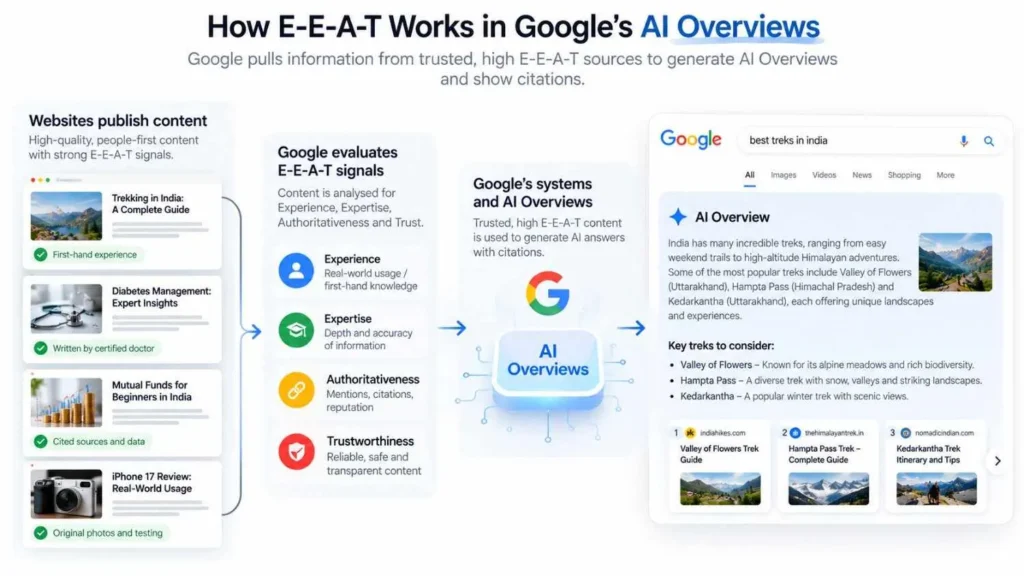
E-E-A-T has quietly become the entry filter for AI search. Study after study of AI Overview citations in 2026 finds the same thing: the vast majority of cited pages have a named author, visible credentials and sourced claims. And the share of citations coming from the organic top 10 has fallen from roughly three-quarters in mid-2025 to under half this year. Ranking gets you into the room. Trust gets you quoted.
Engine | What it leans on |
|---|---|
ChatGPT | Encyclopaedic, heavily cited sources |
Perplexity | Industry publications and structured comparisons |
Google AI Overviews / AI Mode | The widest mix, with extra weight on Knowledge Graph entities |
I went deep on this in how AI search chooses what to cite and in my GEO guide. The short version: GEO is just E-E-A-T made machine-readable.
Our Production Rule for Client Content
AI can draft the structure. A named human expert adds the examples, the numbers and the screenshots, and signs it. Every statistic links to a primary source. Nothing goes live that the author couldn’t defend on a call.
A 10-Minute E-E-A-T Self-Check
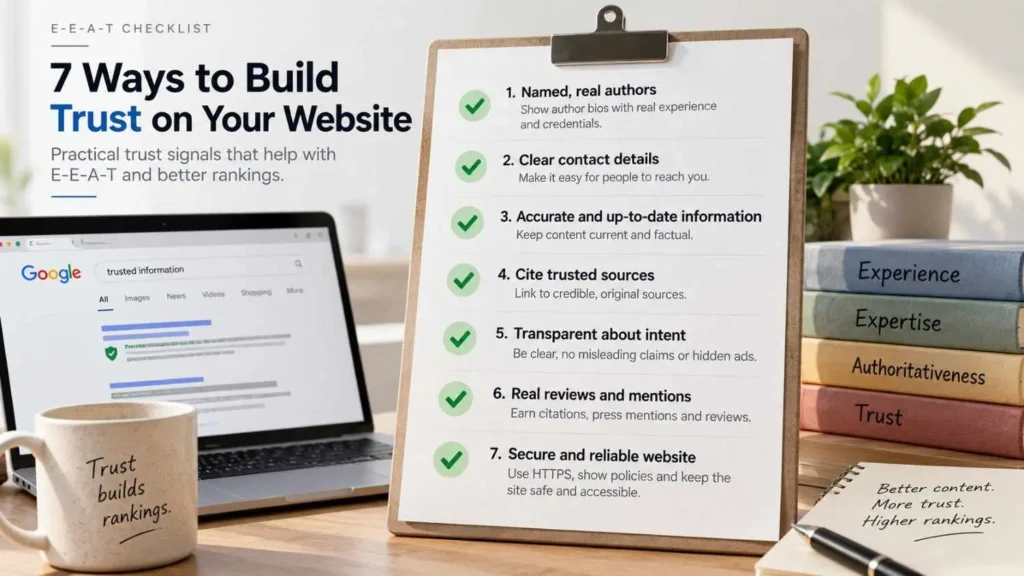
Before you spend on anything, score your site on these ten. Give yourself 0, 1 or 2 for each.
# | Check | Score (0 / 1 / 2) |
|---|---|---|
1 | Every article has a named author with a real bio page | |
2 | Those credentials can be verified somewhere other than your site | |
3 | Your key pages carry original images or screenshots, not stock | |
4 | YMYL content has a named expert reviewer and a review date | |
5 | Your About page names real people and the legal entity | |
6 | Contact details are crawlable text and match your Google Business Profile | |
7 | Published and updated dates are visible and honest | |
8 | You’ve earned at least one press mention or citation in the last 12 months | |
9 | Googling your brand plus “review” or “scam” shows nothing unanswered | |
10 | Article, Person and Organization schema match what’s actually on the page |
Your total | What it means | Do this first |
|---|---|---|
Under 10 | You’re exposed in the next core update | Fix items 5–7 this week |
10–15 | Average | Add expert review and experience assets to your top 20 pages |
16–20 | Strong; authority is the gap | Go earn mentions |
Frequently Asked Questions
What does E-E-A-T stand for?
Experience, Expertise, Authoritativeness and Trustworthiness, from Google’s Search Quality Rater Guidelines. Trust matters most.
What’s the difference between E-A-T and E-E-A-T?
E-A-T (2014) covered Expertise, Authority and Trust. Google added Experience on 15 December 2022 to recognise content from people who have actually used the product or done the thing.
Is E-E-A-T a ranking factor?
Not directly. There’s no score. Google trains its ranking systems on signals that approximate E-E-A-T, so in practice pages with strong E-E-A-T rank better and get cited more.
Can AI-generated content have good E-E-A-T?
Yes, if a named human expert adds first-hand experience, checks the facts, cites sources and puts their name on it. Mostly auto-generated pages with little originality can be rated Lowest under the 2025 guidelines.
How long does it take to improve E-E-A-T?
Trust fixes show within weeks. Author and content improvements show across one or two core updates. Authority is a six-to-twelve-month job, but it compounds.
Final Thoughts
E-E-A-T is Google writing down, in plain language, what it wants the web to be: content made by people who’ve done the thing, who know the subject, who are recognised for it, and who can be trusted. Every core update since 2018 and every AI citation study this year points the same way. The brands winning right now, in Delhi or in Denver, stopped optimising for a crawler and started proving themselves to a sceptical human.
Three things to take away:
- Put real, verifiable people behind your content
- Add first-hand proof to the pages that make you money
- Start earning mentions where your audience already reads
The rankings, the AI citations and the conversions follow.
Want an outside pair of eyes?
E-E-A-T and AI-visibility audits are part of my SEO consulting and AI SEO consulting work. Book a free consultation and I’ll send you the scored checklist above, filled in for your domain. No pitch deck, just the numbers.